Metal Roofs and Modern Connectivity
In an era where staying connected isn’t just convenient, it’s essential, the question “Will a metal roof kill my cell signal?” ranks among the top concerns for homeowners considering this durable roofing option. Between remote work video calls, smart home devices, and emergency 911 access, reliable cellular connectivity has become as critical as electricity and running water.
Metal roofing installations have surged 15% annually over the past decade, driven by their exceptional longevity (50-70 years), energy efficiency, and modern aesthetics. If you’re exploring your options, our metal roofing services page covers everything you need to know about modern metal roof systems. Yet the persistent myth that metal roofs create cell phone “dead zones” causes many homeowners to hesitate. The truth is more nuanced than the black-and-white fears suggest, and far more manageable than you might think.
This guide cuts through the confusion with science-backed data, real-world measurements, and practical solutions that let you enjoy metal roofing’s benefits without sacrificing connectivity.
Understanding How Cell Signals Work
The Basics of Cellular Communication
Your cell phone communicates with nearby towers using radio waves, invisible electromagnetic signals traveling at the speed of light. These radio frequencies operate between 700 MHz and 2,500 MHz for 4G LTE networks, with newer 5G networks extending into even higher frequencies (up to 39,000 MHz or 39 GHz for high-band 5G).
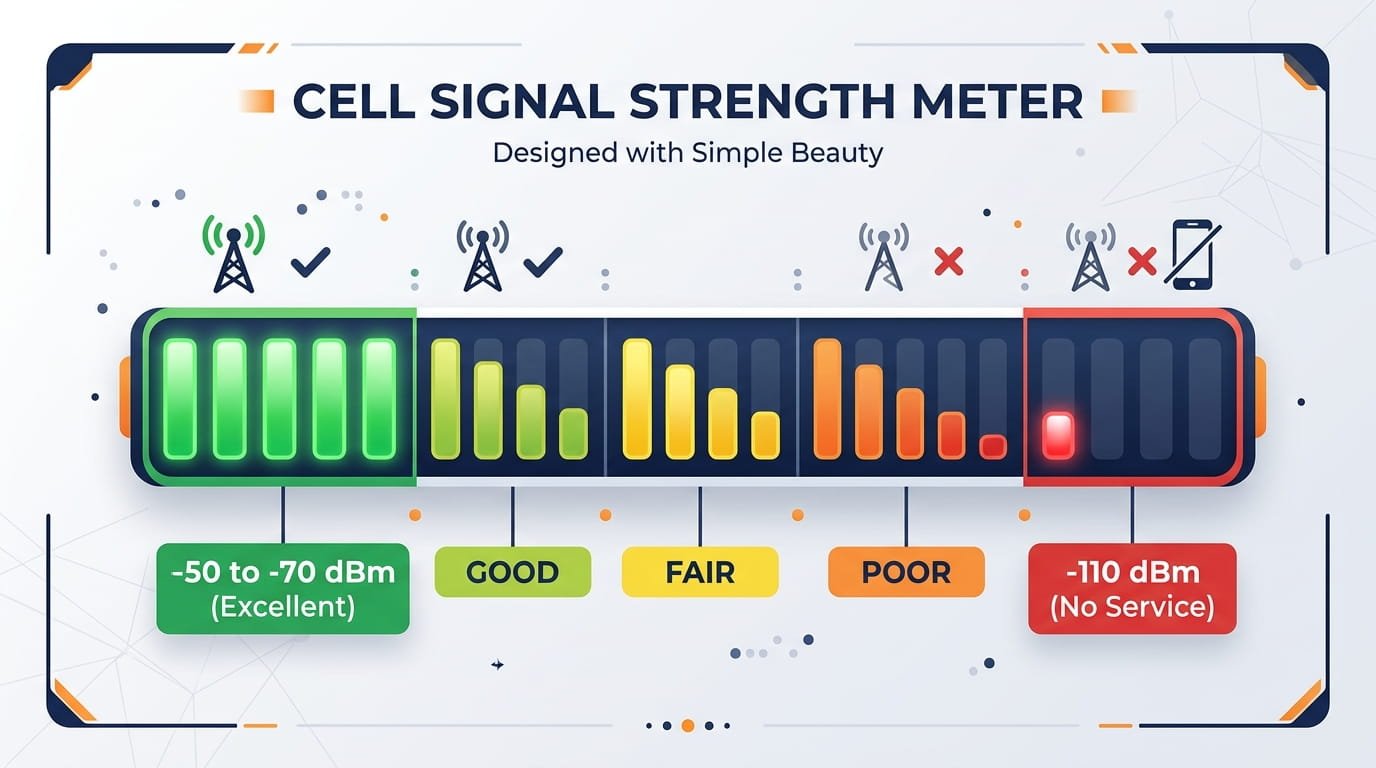
Signal strength is measured in dBm (decibels relative to one milliwatt). Understanding this scale helps you quantify actual impact:
- -50 to -70 dBm: Excellent signal (4-5 bars)
- -70 to -85 dBm: Good signal (3-4 bars)
- -85 to -100 dBm: Fair signal (2-3 bars)
- -100 to -110 dBm: Poor signal (1-2 bars)
- Below -110 dBm: Very poor or no service (0-1 bar)
When signals encounter obstacles, buildings, trees, or roofing materials, they can be reflected, absorbed, or allowed to pass through with varying degrees of attenuation (signal loss).
The Science Behind Metal and Radio Waves
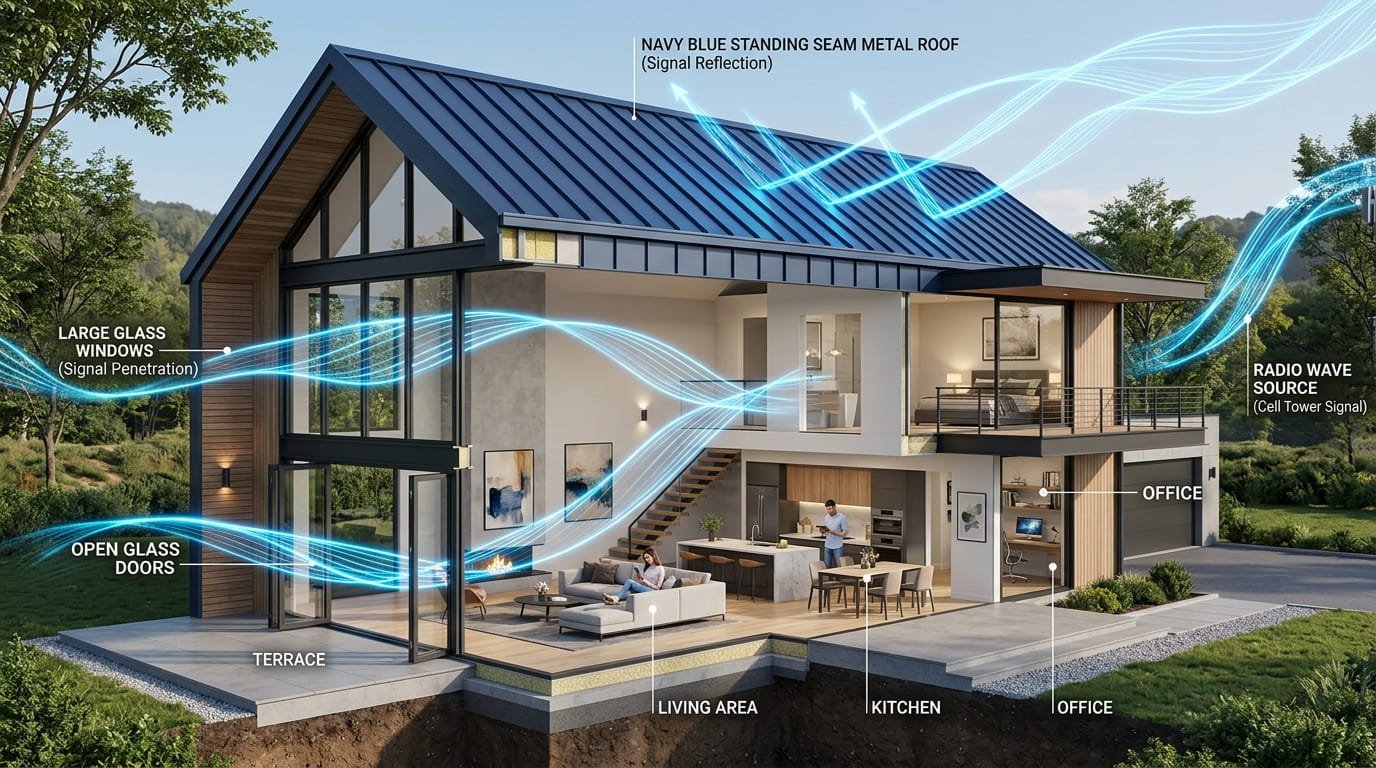
Metal’s unique atomic structure makes it an excellent conductor of electricity and electromagnetic waves. When radio signals hit metal surfaces, two primary interactions occur:
Reflection: Metal surfaces act like mirrors for radio waves, bouncing them in different directions rather than allowing straight-through penetration. This redirects signals away from their intended path.
Absorption: Some signal energy converts to heat as it interacts with the metal’s free electrons. This reduces overall signal strength.
This phenomenon relates to the Faraday cage effect, the principle that electromagnetic fields don’t penetrate enclosed metal structures effectively. However, homes aren’t perfect Faraday cages; signals enter through windows, doors, gaps, and even penetrate partially through walls. A related property that often surprises homeowners is that metal roofs are not magnetic, which has its own set of interesting implications for installation and maintenance.
Do Metal Roofs Really Affect Cell Service?
The Short Answer: Yes, But Not Catastrophically
Metal roofs do reduce cell signal strength, but the impact typically ranges from 10-20 dB loss, equivalent to one or two signal bars on your phone. This translates to approximately 10-20% signal reduction in real-world conditions.
However, context matters enormously. Consider these scenarios:
Minimal Impact Situations:
- Homes within 1-2 miles of cell towers (strong baseline signal)
- Urban/suburban areas with multiple tower coverage
- One-story homes where most living spaces aren’t directly under the roof
- Homes with many windows providing alternative signal paths
Noticeable Impact Situations:
- Rural homes 5+ miles from nearest tower (weak baseline signal)
- Multi-story homes where bedrooms occupy top floors
- Areas with limited carrier tower density
- Homes with few windows or thick wall construction
Professional measurements show that while metal roofs contribute to signal loss, they’re rarely the primary culprit. Distance from cell towers, energy-efficient Low-E windows (20-40 dB loss), and concrete walls (10-20 dB loss) often impact signals more significantly than roofing material.
Different Metal Roof Types and Their Impact
Not all metal roofs affect signals equally. The style, thickness, and coating influence electromagnetic interference levels. Before choosing a metal roof type, it’s worth consulting our roofing inspection experts who can assess your home’s specific needs.
Standing Seam Metal Roofing
The most popular residential metal roofing style features vertical panels with raised seams. The continuous metal surface provides consistent reflection, though the vertical orientation means signals hitting at certain angles may find gaps between panels. Signal impact: moderate to high (15-20 dB loss).
Corrugated Metal Roofing
The wave pattern in corrugated roofing creates varying signal paths. Valleys between ridges can trap signals, while peaks reflect them at different angles. This scattering effect can actually reduce dead zone severity compared to flat panels. Signal impact: moderate (12-18 dB loss).
Metal Shingle/Tile Roofing
These systems create multiple layered surfaces with air gaps between pieces. While still reflective, the gaps allow some signal penetration. Signal impact: moderate (10-15 dB loss).
Metal Roof Thickness
Gauge matters, though not dramatically. Thicker 24-gauge steel (0.024 inches) blocks slightly more signal than thinner 29-gauge (0.014 inches), but the difference measures only 2-3 dB, rarely noticeable in practice.
Stone-coated steel roofing, despite its granular covering, performs nearly identically to bare metal since the coating is too thin to meaningfully affect radio wave behavior. Proper metal roof ventilation design can also influence how signals travel through and around your roof structure, making ventilation planning an important part of the overall installation.
Frequency-Specific Analysis: 4G vs. 5G
4G LTE and Metal Roofs
Lower-frequency 4G signals (particularly the 700-900 MHz “low band” spectrum) penetrate building materials better than higher frequencies. Most homeowners with 4G service report manageable connectivity under metal roofs, especially if their carrier uses low-band spectrum.
Mid-band 4G frequencies (1700-2100 MHz) experience more interference from metal roofing but generally maintain usable service.
5G Technology Challenges
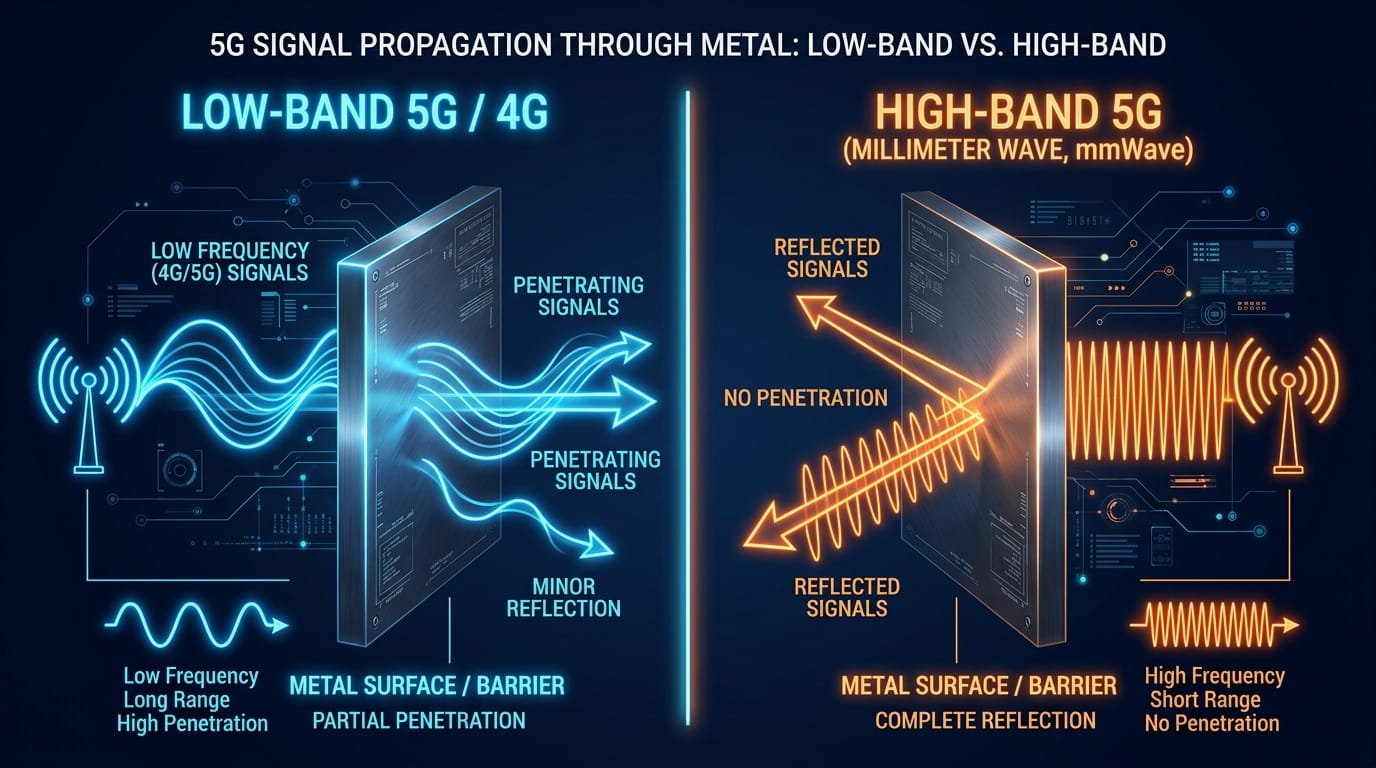
5G networks operate across three frequency ranges with dramatically different penetration characteristics:
Low-band 5G (600-900 MHz): Similar to 4G low-band, these signals handle metal roofs reasonably well. T-Mobile’s extensive low-band 5G network performs particularly well with metal roofing.
Mid-band 5G (2.5-3.7 GHz C-band): These frequencies experience moderate interference from metal roofs, roughly 20-25% signal reduction. Adequate for most applications but may require signal boosting in challenging locations.
High-band 5G (24-39 GHz millimeter wave): These ultra-fast signals are severely impacted by metal roofing, concrete walls, and even heavy rain. Millimeter wave 5G typically requires outdoor antennas for metal-roofed homes, though its limited deployment (mostly dense urban areas) means most homeowners don’t yet need to worry about it.
Carrier Differences
AT&T, Verizon, and T-Mobile use different frequency combinations that affect metal roof performance:
- T-Mobile: Heavy low-band 600 MHz deployment provides best metal roof penetration
- Verizon: Mid-band focus requires better signal boosting solutions
- AT&T: Mixed spectrum with reasonable low-band coverage in most markets
Testing Your Signal Strength
Before panicking about potential metal roof interference, measure your actual signal strength:
DIY Testing Methods
iPhone Users: Dial *3001#12345#* and press call to enter Field Test Mode. Look for “Measured RSSI” or “RSRP” values showing dBm readings.
Android Users: Install free apps like “Network Cell Info Lite” or “OpenSignal” to view detailed signal measurements.
Walk through your home noting dBm readings in different rooms. Compare these to outdoor readings to quantify building material impact. Create a simple map marking areas with poor signal (below -100 dBm).
Professional Assessment
Signal assessment services ($150-500) provide comprehensive analysis using professional spectrum analyzers. Technicians measure signal strength across all carrier frequencies, identify interference sources, and recommend optimal booster placement. Consider professional testing if DIY measurements show severe issues or you’re planning expensive solutions. Similarly, if you’re still in the planning stages of your roof, a professional roofing inspection can help identify structural and material factors that may influence both signal performance and overall roof health.
Comprehensive Solutions: How to Boost Cell Signal
The good news: multiple effective solutions exist at various price points.
Cell Phone Signal Boosters
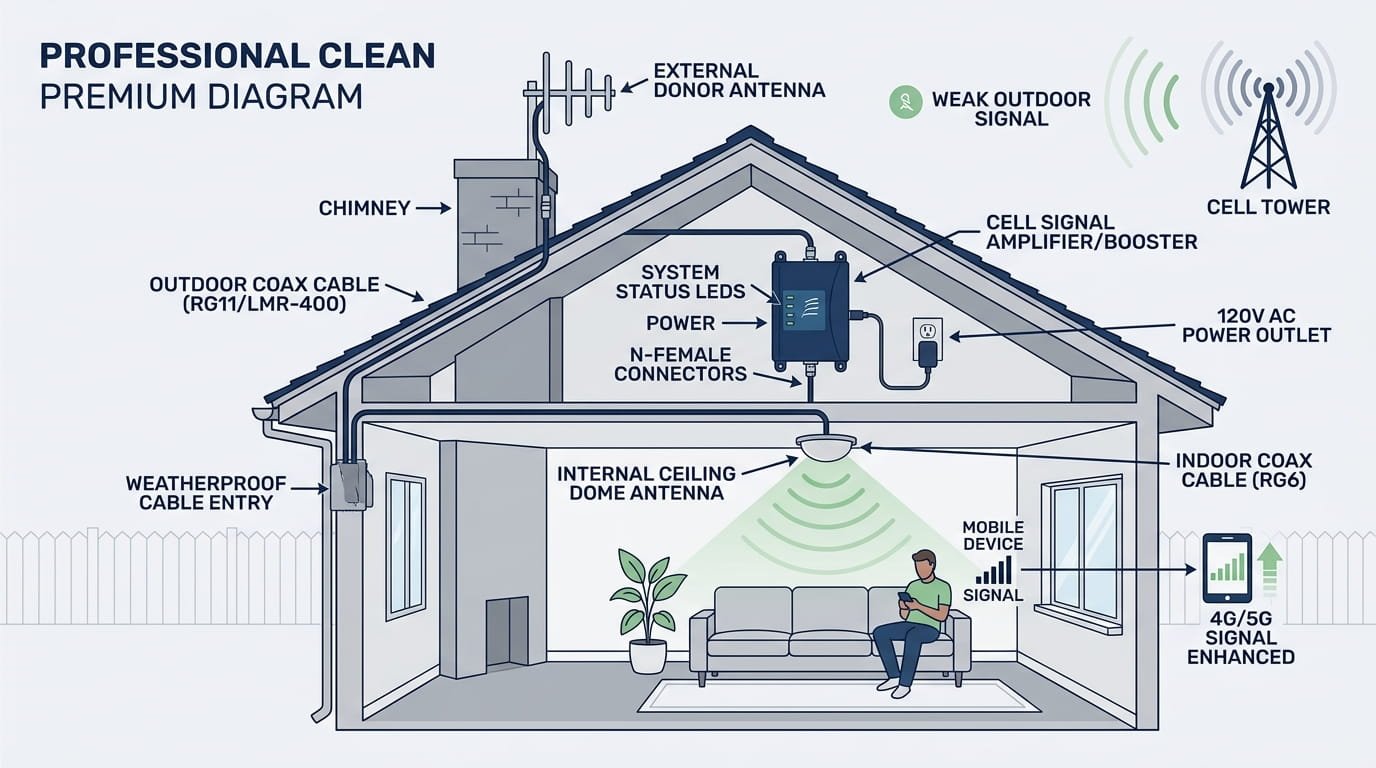
Signal boosters remain the most popular solution for metal-roofed homes. These systems use three components:
- External antenna mounted outside to capture existing signal
- Amplifier that boosts signal strength by 20-30 dB
- Internal antenna(s) that rebroadcast strengthened signal inside
Cost Analysis:
- Entry-level single-room boosters: $200-400 (weBoost Home Room, SureCall Flare)
- Mid-range whole-home systems: $400-800 (weBoost Home MultiRoom, SureCall Fusion4Home)
- Professional multi-story systems: $800-2,000+ (Wilson Pro, SureCall Force8)
- Professional installation: $200-600 (optional, DIY possible)
ROI Perspective: If poor connectivity forces you to maintain an expensive unlimited data plan instead of switching to Wi-Fi calling with cheaper limited data ($40/month savings), a $500 booster pays for itself in 12-13 months.
All consumer boosters must be FCC-certified to prevent network interference. Reputable brands automatically comply with regulations. For detailed FCC guidelines on approved signal boosters, refer to the FCC’s official consumer guide on signal boosters.
Femtocell Solutions
Carriers offer femtocells (also called network extenders or microcells) that create mini cell towers using your broadband internet connection. These work independently of existing cellular signal strength.
Carrier Options:
- AT&T MicroCell: Free with qualifying plans
- Verizon Network Extender: $0-250 depending on account
- T-Mobile 4G LTE CellSpot: Free for postpaid customers
Pros: Carrier-integrated, reliable, no external antenna needed Cons: Requires high-speed internet (10+ Mbps), limited range (typically 40 feet), may count against data caps
Wi-Fi Calling: The Alternative Solution
Every major carrier now supports Wi-Fi calling, allowing your phone to route calls and texts through your internet connection instead of cellular towers. Enable this feature in your phone settings under “Wi-Fi Calling” or “Connections.”
Advantages:
- Uses existing internet, no additional equipment cost
- Works anywhere with Wi-Fi (including internationally)
- Seamless handoff to cellular when leaving home
- Free with unlimited talk plans
Considerations:
- Requires reliable home internet
- Quality depends on internet speed
- May not work with all phone models
- 911 location services can be less accurate
Mesh Wi-Fi Systems
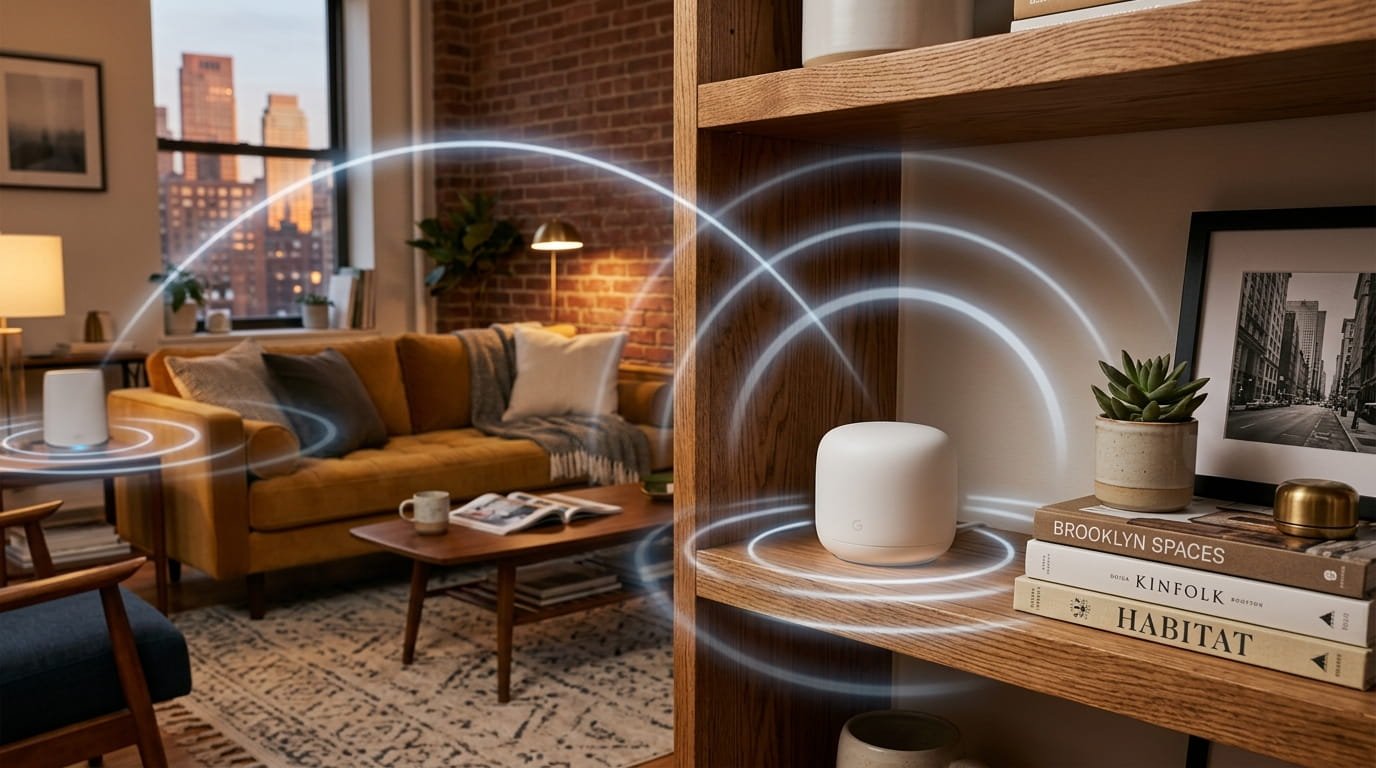
For homes relying on Wi-Fi calling, mesh systems ($200-600) eliminate dead zones by creating seamless coverage across multiple access points. Top options include Google Nest WiFi ($269 for 3-pack), Amazon Eero Pro 6 ($299), and Netgear Orbi ($400-600).
Combining Solutions
Many homeowners achieve optimal results by combining approaches: mesh Wi-Fi for general connectivity + Wi-Fi calling for phone service + single-room signal booster for areas where cellular absolutely must work (home office, bedroom).
Real-World Case Studies
Case Study 1: Rural Home with Metal Roof
Location: 6 miles from nearest tower, mountainous terrain Problem: 2-bar signal dropped to 1 bar after metal roof installation; frequent dropped calls Solution: weBoost Home MultiRoom signal booster ($549) Installation: DIY, 3 hours with roof-mounted external antenna Result: Consistent 4-5 bars throughout home; zero dropped calls in 18 months Verdict: “Booster paid for itself vs. driving to town for work calls”
Case Study 2: Urban Multi-Story Home
Location: 2 miles from tower, dense suburban area Problem: Top floor bedrooms had weak signal (2 bars) under new standing seam metal roof Solution: Google Nest WiFi mesh system ($269) + carrier Wi-Fi calling Installation: 30 minutes, plug-and-play Result: Seamless coverage on all floors; family doesn’t notice metal roof impact Verdict: “Cheapest solution that actually worked perfectly”
Case Study 3: Suburban Home Near Tower
Location: 1.5 miles from tower, flat terrain Problem: Homeowner worried about metal roof impacting 5-bar signal Solution: None, signal remained strong (4-5 bars) after installation Result: No measurable impact; occasional drop to 4 bars in specific rooms Verdict: “Worried for nothing; metal roof was worth it”
Frequently Asked Questions
Do metal roofs completely block cell phone signals? No. Metal roofs reduce signal strength by approximately 10-20%, not create complete dead zones. Millions of homes with metal roofs maintain adequate cell service.
How much signal loss should I expect with a metal roof? Typical signal reduction measures 10-20 dB (decibels), equivalent to 1-2 bars on your phone display. The practical impact depends on your baseline signal strength before the roof installation.
Will I still be able to make 911 emergency calls? Yes. Emergency calls receive priority on cellular networks and will connect even with weak signals. However, if you live in an area with marginal coverage, a signal booster provides peace of mind.
Are signal boosters legal and safe to use? Yes, when FCC-certified. All major brands (weBoost, SureCall, HiBoost) sell only certified equipment that meets power output limits and interference prevention standards. Uncertified boosters from overseas sellers should be avoided.
Can I use Wi-Fi calling instead of worrying about cell signal? Absolutely. Wi-Fi calling provides excellent voice quality and works independently of cellular signal strength. This represents the simplest, most cost-effective solution for many homeowners.
Do metal roofs affect 5G service more than 4G? Yes, particularly high-band millimeter wave 5G (24-39 GHz). However, most carriers’ 5G networks primarily use low-band and mid-band frequencies similar to 4G, experiencing comparable metal roof impact. T-Mobile’s low-band 5G penetrates metal roofs particularly well.
What’s the best signal booster brand for metal roofs? weBoost and SureCall lead the market in reliability and performance. For whole-home coverage under metal roofs, the weBoost Home MultiRoom ($549) and SureCall Fusion4Home ($599) receive consistently positive reviews. Entry-level users find the weBoost Home Room ($229) adequate for single-room solutions.
What other factors affect my roof’s overall performance beyond cell signal? Great question. Proper metal roof insulation plays a major role in energy efficiency and temperature regulation. You may also want to review our roof maintenance guide to keep your metal roof performing at its best for decades.
Conclusion: Making an Informed Decision
Metal roofs do affect cell service, but the impact is manageable, measurable, and solvable. The 10-20 dB signal reduction rarely creates deal-breaking connectivity problems, especially in areas with reasonable baseline coverage.
When Metal Roofs Aren’t a Concern:
- You live within 3 miles of cell towers
- You currently have 4-5 bar signal strength
- You’re willing to use Wi-Fi calling
- You live in a one-story home
When to Plan for Signal Solutions:
- Rural locations 5+ miles from towers
- Multi-story homes with bedroom/office spaces on top floors
- Areas with weak existing coverage (1-2 bars)
- Mission-critical connectivity needs (remote work, medical monitoring)
The typical solution investment ($200-600) pales in comparison to metal roofing’s 50-70 year lifespan and energy savings. Don’t let exaggerated fears about cell signal deter you from metal roofing’s substantial benefits. With modern signal boosting technology, Wi-Fi calling, and strategic planning, you can enjoy both superior roofing and seamless connectivity.
Before installation, test your current signal strength, research your carrier’s local frequencies, and budget $300-500 for potential signal enhancement if needed. Most homeowners find that metal roofing’s durability, efficiency, and aesthetics far outweigh the minor connectivity adjustments required. Ready to move forward? Contact our roofing experts today for a consultation, or explore our full range of residential roofing solutions to find the best fit for your home.
For more expert insights on metal roofing topics, visit our roofing blog where we regularly publish guides to help homeowners make informed decisions. You can also review the U.S. Department of Energy’s guidance on metal roofing energy benefits for independent, authoritative information on long-term efficiency savings.