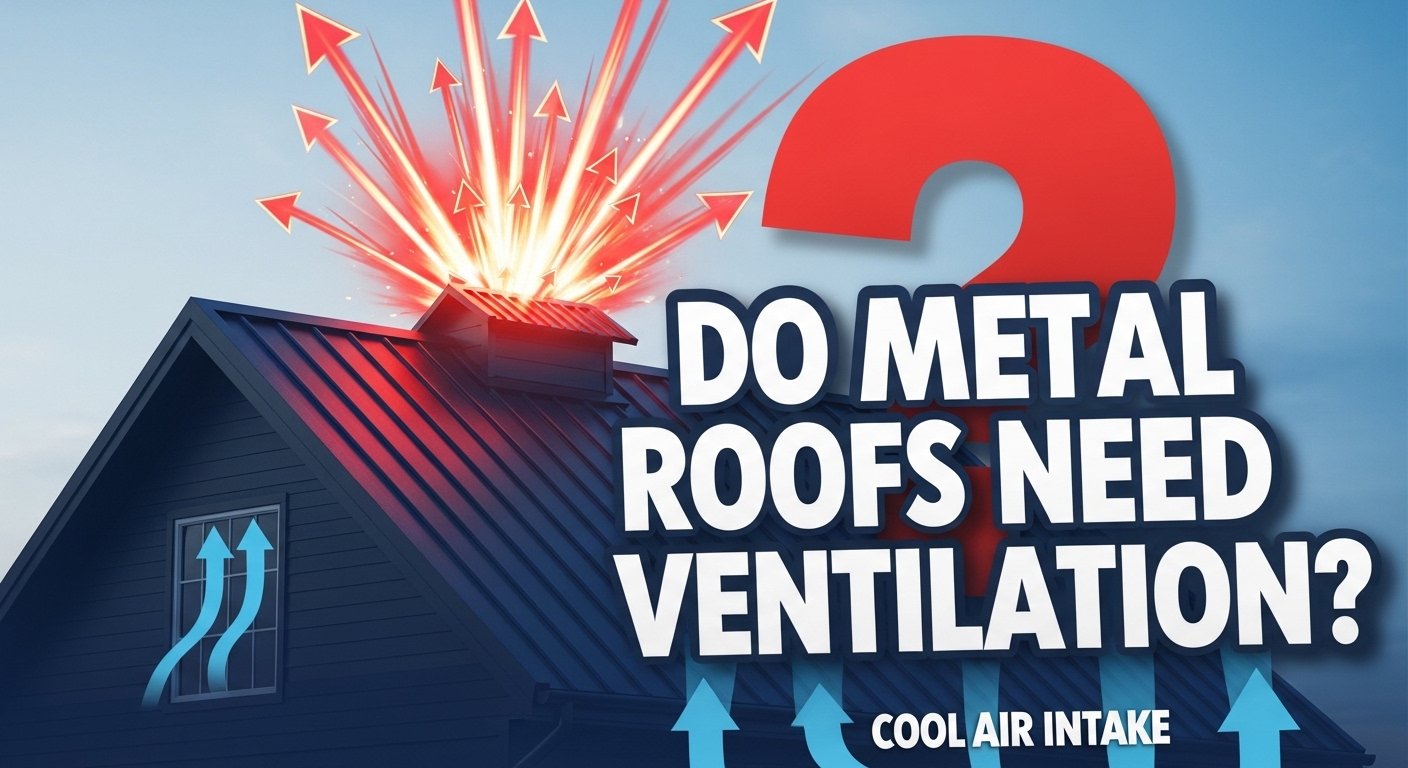
When homeowners invest in a metal roof, they often overlook one critical component that separates a 50-year roof from a 15-year disaster: proper ventilation. The question “Does a metal roof need ventilation?” isn’t just technical jargon, it’s the difference between protecting your investment and watching thousands of dollars rust away beneath a beautiful exterior.
The Short Answer: Yes, and Here’s Why It Matters
Let’s cut through the noise: Yes, metal roofs absolutely need ventilation. This isn’t a building code technicality or an upsell from contractors. It’s physics, and physics doesn’t negotiate.
Here’s the brutal reality: An unvented metal roof is essentially a sealed container trapping moisture, heat, and problems. Within months, you might notice condensation dripping from the underside of your panels. Within years, you could face structural wood rot, insulation damage, and voided warranties. The metal itself might survive, but everything underneath could be quietly deteriorating.
Busting the “Metal Sweats” Myth
You’ve probably heard someone say, “Metal roofs sweat.” That’s not quite accurate. Metal doesn’t sweat any more than your car’s windshield sweats on a cold morning. What’s happening is condensation, warm, moist air from your living space hits the cold metal surface, and water droplets form. Without ventilation to carry away that moisture-laden air, you’re creating a greenhouse effect in reverse: a cold, wet environment perfect for mold and wood decay.
The stakes are high. Poor ventilation affects:
- Energy bills (trapped heat in summer means your AC works overtime)
- Structural integrity (rust on fasteners, rot in roof decking)
- Indoor air quality (mold growth from trapped moisture)
- Warranty coverage (many manufacturers void warranties on improperly vented roofs)
This guide will walk you through the science, the calculations, the products, and the step-by-step process of proper metal roof ventilation. Whether you’re a DIY enthusiast planning a metal roof install or a homeowner wanting to understand what your contractor is doing, you’ll leave with actionable knowledge.
The Science: Why Metal Roof Venting is Non-Negotiable
Understanding why ventilation matters starts with understanding what happens inside your roof assembly when temperatures and humidity levels clash.
Condensation Mechanics: The Dew Point Problem
During winter, your heated home pumps warm, moist air upward. This air naturally rises into your attic space. When this warm air encounters the cold metal roofing panel, chilled by outside winter temperatures, the temperature drops below the dew point, and condensation forms. It’s the same principle that creates fog on your bathroom mirror after a hot shower.
Without ventilation, this moisture has nowhere to go. It accumulates on the underside of the metal, drips onto insulation (reducing its R-value by up to 50%), soaks into wood decking, and creates the perfect environment for mold and mildew.
Thermal Movement: The Expansion Challenge
Metal expands and contracts with temperature changes, significantly more than asphalt shingles. A 100-foot metal roof can expand up to 9 inches on a hot summer day. When heat builds up in an unvented attic (temperatures can reach 150°F or higher), this constant expansion-contraction cycle stresses fasteners, can cause oil-canning (waviness in the panels), and accelerates wear on sealants and gaskets.
Vented Metal Roof vs. Unvented: Cold Roofs and Hot Roofs
In roofing terminology, you’ll hear about “cold roofs” and “hot roofs”:
- Cold Roof (Vented): The roof deck stays close to outdoor temperature because ventilation removes heat buildup. This is the standard for residential metal roofing and prevents ice dams in winter.
- Hot Roof (Unvented): Insulation is placed directly against the roof deck with no air gap. This approach is sometimes used with spray foam insulation in certain commercial applications, but it requires precise installation and isn’t typical for residential metal roofing.
For metal roofs, the cold roof approach with proper ventilation is the gold standard. It’s what building codes require, what manufacturers recommend, and what science supports.
How Are Metal Roofs Vented? (Step-by-Step Process)
Understanding the ventilation pathway is crucial. It’s not just about cutting holes in your roof, it’s about creating a system where air flows naturally from bottom to top.
Step 1: The Intake (Soffit Vents)
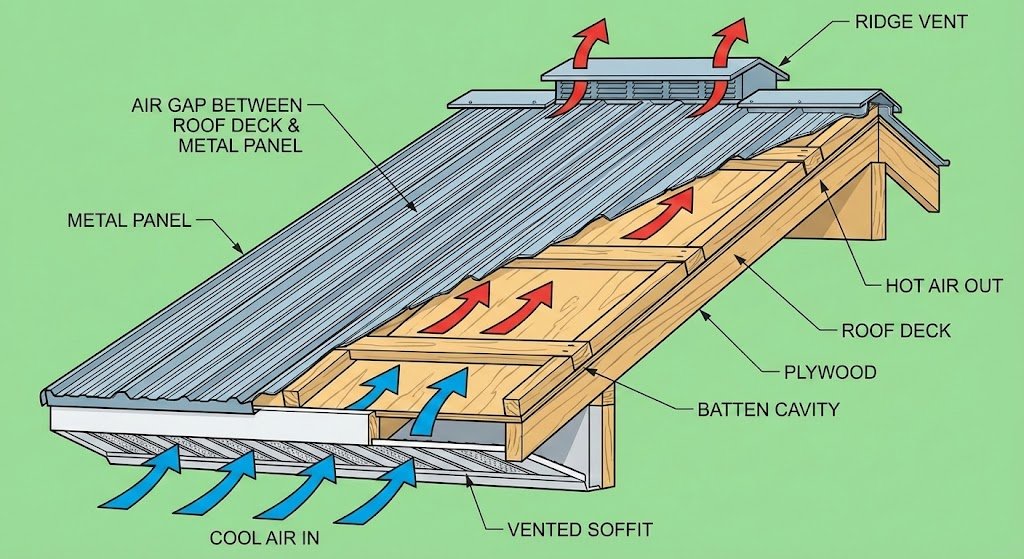
The ventilation journey begins at the lowest point of your roof: the soffit (the underside of your roof overhang). Soffit vents allow cool, fresh air to enter the attic space. Think of these as the lungs of your roof system, without adequate intake, nothing else works.
Proper soffit venting means:
- Continuous perforated soffit material, or
- Individual soffit vents spaced regularly
- Clear pathways (insulation baffles prevent insulation from blocking airflow)
Step 2: The Air Channel (Creating the Gap)
Here’s where metal roof installation differs critically from shingle roofs. You cannot simply lay metal panels directly onto roof decking or over old shingles and expect proper ventilation.
Battens or Purlins are the secret. These are wood or metal strips (typically 1×4 or 2×4) installed vertically from eave to ridge over the roof deck. The metal panels attach to these battens, creating a continuous air channel between the roof deck and the metal.
This gap (usually 1.5 to 3.5 inches) serves two purposes:
- Airflow pathway for ventilation
- Thermal break reducing heat transfer
Step 3: The Stack Effect (Natural Convection)
Physics takes over once you’ve created the pathway. As the sun heats your metal roof, the air in the channel warms up. Hot air rises (it’s less dense), creating an upward draft. This pulls cool air in through the soffit vents and pushes hot air out through the ridge, all without fans or electricity.
This “stack effect” or “chimney effect” is remarkably effective. Even on windless days, temperature differentials create airflow. On breezy days, wind passing over the ridge vent creates negative pressure that accelerates the exhaust.
Step 4: The Exhaust (Ridge Vents)
At the peak of your roof, ridge vents allow hot air to escape. For metal roofs, you need ridge vents specifically designed to work with your panel profile. Standard ridge vents from asphalt shingle installations won’t work.
Calculating Airflow: The Rules of Venting a Metal Roof
Ventilation isn’t a “more is better” game, it’s a balanced system. Too much exhaust without enough intake creates negative pressure that can actually pull moisture into your attic. Here’s how to calculate what you need.
The 1/300 Rule: Building Code Baseline
Most building codes require 1 square foot of net free ventilation area for every 300 square feet of attic floor space. For example:
- 1,200 sq ft home = 4 square feet of ventilation needed
- 2,400 sq ft home = 8 square feet of ventilation needed
However, this can be reduced to 1/600 if you have a properly balanced system with intake and exhaust ventilation and meet certain conditions.
Understanding Net Free Area (NFA)
Here’s where many DIYers make mistakes. A 12-inch by 12-inch vent doesn’t provide 144 square inches of ventilation. Screens, louvers, and baffles reduce the actual open area. This reduced measurement is the Net Free Area.
Most vent products list their NFA on the packaging. A typical 12×12 soffit vent might only have 50-60 square inches of NFA, about 40% of its overall size.
The 50/50 Balance Rule
For optimal performance, you need equal intake and exhaust. The ideal split:
- 50% of total NFA at the intake (soffit vents)
- 50% of total NFA at the exhaust (ridge vent)
If you have too much exhaust and insufficient intake, the system will pull air from unintended sources, through attic bypasses, creating negative pressure, potentially pulling conditioned air from your living space.
Example Calculation:
- 1,800 sq ft home needs 6 sq ft total NFA (using 1/300 rule)
- Convert to square inches: 6 × 144 = 864 square inches
- Intake needed: 432 square inches NFA (soffit)
- Exhaust needed: 432 square inches NFA (ridge)
Best Roof Vents for Metal Roofs: A Product Comparison
Not all vents are created equal, and what works beautifully on asphalt shingles might fail spectacularly on metal. Here’s what actually works.
1. Continuous Ridge Vents: The Gold Standard
For metal roofing, continuous ridge vents designed specifically for metal panels are the best solution. These run the entire length of your ridge, providing maximum exhaust capacity while maintaining a clean, low-profile appearance.
Why they’re the best:
- Aesthetically pleasing (blend with roof lines)
- Maximum NFA per linear foot
- No penetration points to leak (when properly installed)
- Even air distribution
Profile-Vented Closures: For corrugated or ribbed metal panels, you need closure strips with ventilation channels. These custom-fit foam or rubber pieces sit between the panel ribs and the ridge cap, sealing against weather while allowing airflow. Don’t skip these, regular solid closures will completely defeat your ventilation system.
2. Turbine Vents (Whirlybirds): Effective but Aesthetically Challenging
These spinning ventilators use wind to create suction, pulling hot air from the attic. They work well, especially in windy areas, but they’re visually polarizing.
Pros:
- Excellent NFA (300-500 sq in per unit)
- Active ventilation even on calm days
- No electricity required
Cons:
- Roof penetrations (potential leak points)
- Can be noisy in high winds
- Industrial appearance may not suit residential aesthetics
- Require more maintenance (bearings can seize)
For metal roofs, if you choose turbines, ensure proper flashing designed for your panel profile and use butyl tape or compatible sealants.
3. Gable Vents: Often Insufficient Alone
Gable vents placed at the end walls of your attic can provide ventilation, but they rarely move air effectively across the entire attic space. Dead zones develop in areas far from the vents.
Why they fall short for metal roofs:
- Create horizontal airflow instead of bottom-to-top
- Don’t leverage the stack effect
- Leave some areas unventilated
- Can short-circuit ridge vent systems
They’re fine as supplemental ventilation but shouldn’t be your primary strategy.
4. Box Vents/Static Pots: For Complex Roof Shapes
These are individual vents installed through the roof deck. For metal roofs with complex hip-and-valley designs where continuous ridge venting isn’t practical, box vents can fill the gap.
Best practices:
- Use metal-specific flashing boots
- Space according to NFA calculations
- Install closer to the ridge for maximum stack effect
- Seal penetrations with compatible sealants (metal roofs expand/contract)
Special Case: Metal Building Roof Vents (Pole Barns and Agricultural Structures)
Venting a pole barn or metal building presents unique challenges because there’s often no traditional attic floor, just open framing from the ground to the roof deck.
The Challenge: No Attic Space
Without an attic, you can’t use soffit-to-ridge ventilation in the traditional sense. Yet condensation is often worse in these structures due to:
- Large temperature swings (uninsulated or minimally insulated)
- Moisture from animals, equipment, or stored materials
- No vapor barrier in many older structures
Solutions for Metal Building Roof Vents
Deep-Rib Ridge Vents: These specialized ridge vents have taller profiles designed for metal building panels (often 3-5 inches tall) and provide substantial exhaust capacity. Combined with wall vents or soffit-style intake low on the building, they create cross-ventilation.
Cupolas: Traditional but effective, cupolas (small roof structures with vents) sit at the ridge and use the stack effect. For larger barns, cupolas with solar-powered exhaust fans can move significant air volumes.
Sidewall Louvers: Installing intake vents low on sidewalls and exhaust near the ridge creates airflow patterns that, while not as efficient as soffit-to-ridge, still prevent moisture buildup.
Condensation Control: The Vapor Barrier Role
In metal buildings, especially those in humid climates or housing animals, a vapor barrier between the interior and the insulation is critical. This prevents warm, moist air from reaching the cold metal and condensing. Combined with proper ventilation, this one-two punch controls moisture effectively.
Common Mistakes When Venting a Metal Roof
Even experienced contractors sometimes make these critical errors. Knowing them helps you avoid expensive fixes.
Mistake #1: Installing Metal Over Shingles Without Battens
This is the most common and most damaging error. Laying metal panels directly over old shingles or felt paper creates a sealed sandwich with no air movement. Moisture gets trapped between the layers, the old shingles deteriorate rapidly, and condensation forms on the underside of the metal.
The fix: Always install vertical battens over the old roof (or stripped deck) before metal panels. This air gap is non-negotiable.
Mistake #2: Short-Circuiting with Mixed Vent Types
Combining ridge vents with gable vents sounds like more ventilation equals better performance. In reality, it creates a short circuit. Air enters the gable vent, immediately exits the nearby ridge vent, and never travels through the attic space to remove heat and moisture from distant areas.
The fix: Choose either ridge venting (preferred) or gable venting, not both. If both exist, close off gable vents when installing ridge vents.
Mistake #3: Blocked Soffit Intake
You can have the most expensive ridge vent system in the world, but if insulation is packed against the roof deck blocking soffit vents, your ventilation is dead in the water.
The fix: Install insulation baffles (rigid foam or cardboard channels) between every rafter bay. These maintain a clear airway from soffit to ridge even when insulation is present.
Mistake #4: Insufficient NFA Calculation
“Eyeballing it” or assuming a few vents will suffice leads to under-ventilated roofs. Remember, you need to account for the actual Net Free Area, not the vent’s overall size.
The fix: Do the math. Measure your attic floor space, calculate required NFA, check product specifications, and install enough vents to meet or exceed requirements.
Preventing Ice Dams with Proper Airflow
In cold climates, proper ventilation does double duty: it prevents summer heat buildup and winter ice dams.
The Cold Roof Principle for Ice Dam Prevention
Ice dams form when heat from the living space warms the roof deck, melting snow. The meltwater runs down to the cold eaves and refreezes, creating a dam. As more water backs up behind this dam, it seeps under shingles (or metal) and into your home.
A properly vented cold roof keeps the roof deck temperature close to outdoor temperature. Snow doesn’t melt prematurely, and ice dams don’t form.
The ventilation connection:
- Adequate soffit intake brings in cold outdoor air
- Continuous air channel keeps roof deck cold
- Ridge exhaust removes any warm air that rises
- The roof deck stays uniformly cold across its entire surface
Insulation Baffles: The Unsung Hero
Insulation baffles are inexpensive foam or cardboard channels that maintain an open airway from soffit to ridge. Without them, blown-in or batt insulation can block soffit vents, defeating your entire ventilation system.
Install one baffle in each rafter bay, stapled to the roof deck before insulation. This simple step prevents thousands in ice dam damage.
Conclusion: Ventilation Is Not Optional
If you take away one thing from this guide, let it be this: Metal roof ventilation is not a luxury or an upgrade, it’s a fundamental requirement for a roof that performs as promised.
The question “Do metal roofs need to be vented?” has a clear answer: Yes, and proper venting is what separates a metal roof that lasts 50+ years from one that develops problems within a decade.
Final Advice: Don’t Cut Corners on the Air Gap
The most expensive mistake you can make is skipping the air gap between your roof deck and metal panels. The materials to create this gap, battens, ridge vents, soffit vents, cost a fraction of what you’ll spend fixing moisture damage, replacing rotted decking, or re-roofing because a warranty was voided.
Take Action
If you’re planning a metal roof installation:
- Calculate your required NFA using the formulas in this guide
- Choose appropriate vent products for your specific panel profile
- Insist on battens/purlins to create the critical air gap
- Verify balanced intake and exhaust (50/50 split)
If you have an existing metal roof with suspected ventilation issues (condensation, ice dams, excessive heat):
- Inspect your attic for signs of moisture, mold, or frost
- Check soffit vents for blockages
- Verify air gap exists between deck and metal
- Consult a professional for retrofit solutions if needed
Your metal roof is an investment. Proper ventilation ensures that investment pays dividends for decades to come.
Frequently Asked Questions (FAQs)
Can I put a metal roof over shingles without vents?
No, this is one of the worst decisions you can make. Installing metal over shingles without creating an air gap (using battens) and proper intake/exhaust ventilation will trap moisture, void your warranty, and cause the old shingles to deteriorate rapidly. Condensation will form on the underside of the metal, leading to rot, mold, and structural damage. Always install battens to create ventilation space, even when roofing over existing materials.
What is the difference between a hot roof and a cold roof?
A cold roof has ventilation between the insulation and the roof deck, keeping the deck close to outdoor temperature. This is the standard for residential metal roofing. A hot roof has insulation applied directly to the underside of the roof deck with no ventilation space, often using spray foam. While hot roofs can work in specific commercial applications with proper installation, cold roofs are recommended for metal roofing because they prevent ice dams, reduce cooling costs, and manage moisture more effectively.
How do I stop my metal roof from sweating?
“Sweating” is actually condensation forming when warm, moist interior air meets the cold metal surface. To stop it:
- Install proper ventilation (soffit intake, air gap via battens, ridge exhaust)
- Add a vapor barrier on the warm side of insulation to prevent moist air from reaching the metal
- Ensure balanced airflow with equal intake and exhaust
- Use insulation baffles to maintain clear air channels
- Control indoor humidity with proper ventilation in kitchens and bathrooms
The combination of ventilation (removing moist air) and vapor barriers (preventing moist air from reaching cold surfaces) solves 99% of condensation issues.