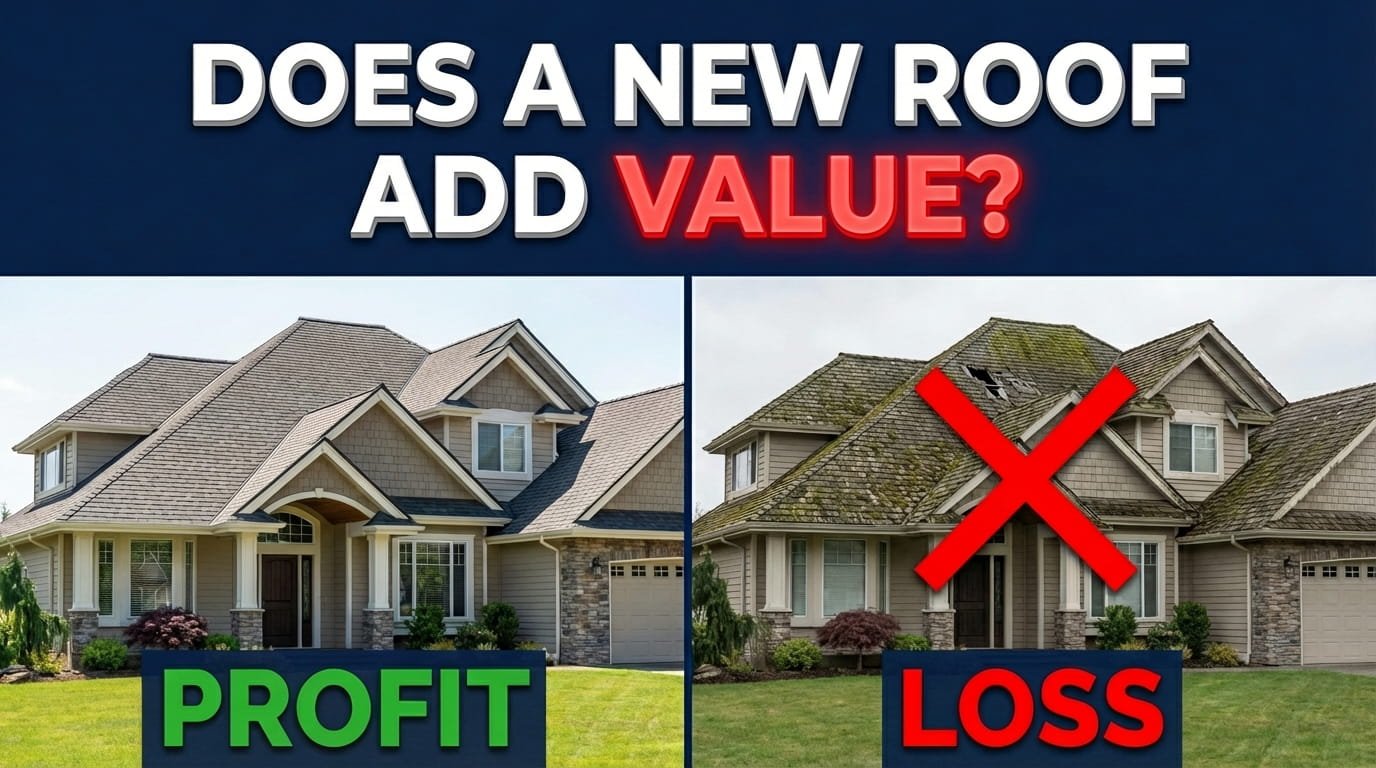
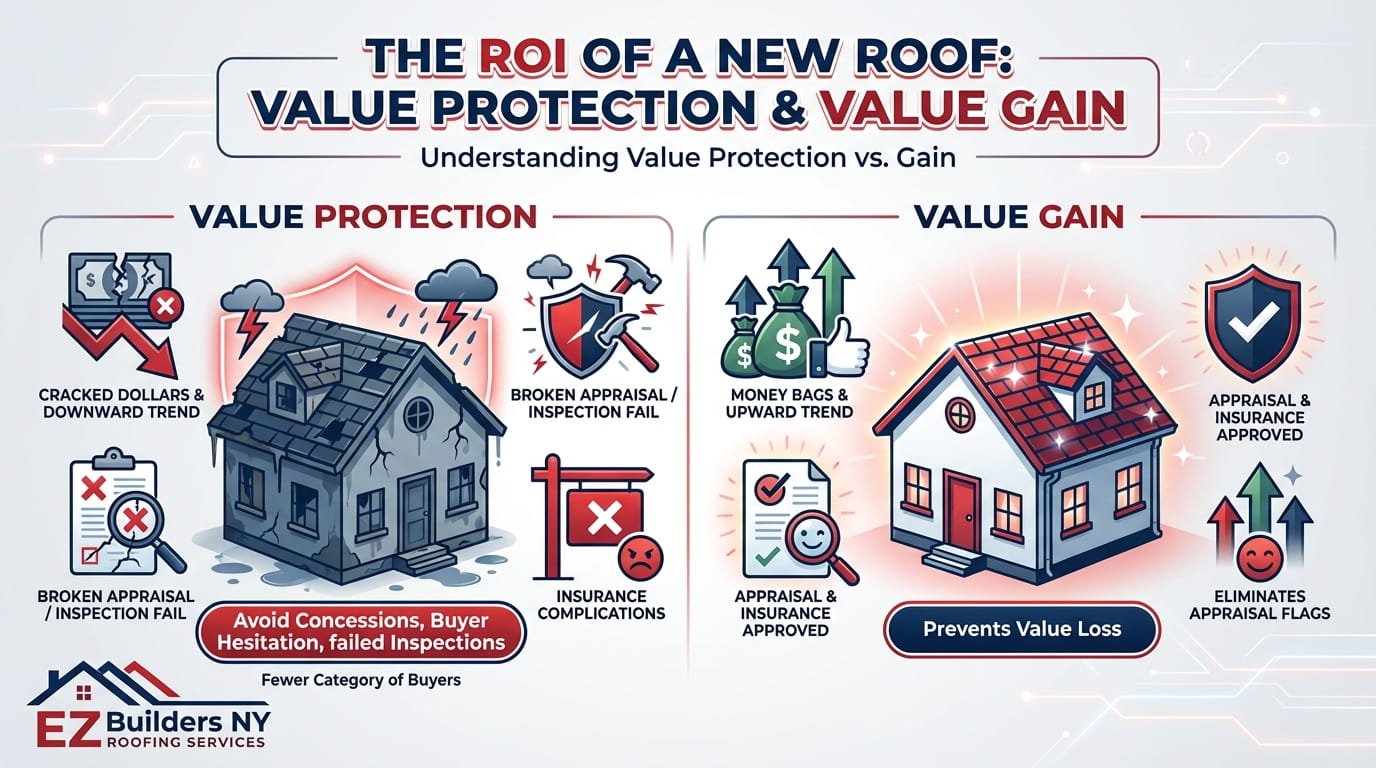
When homeowners ask does a new roof add value? most articles skip the most important nuance: a roof replacement does not add value the way a kitchen remodel does. It primarily prevents value loss. Understanding this distinction is the key to making a financially smart roofing decision, whether you are selling in six months or staying for twenty years.
This guide breaks down the exact ROI numbers, which materials pay back the most, how to decide between repair and replacement, and when a roof investment makes sense even if you have no plans to sell.
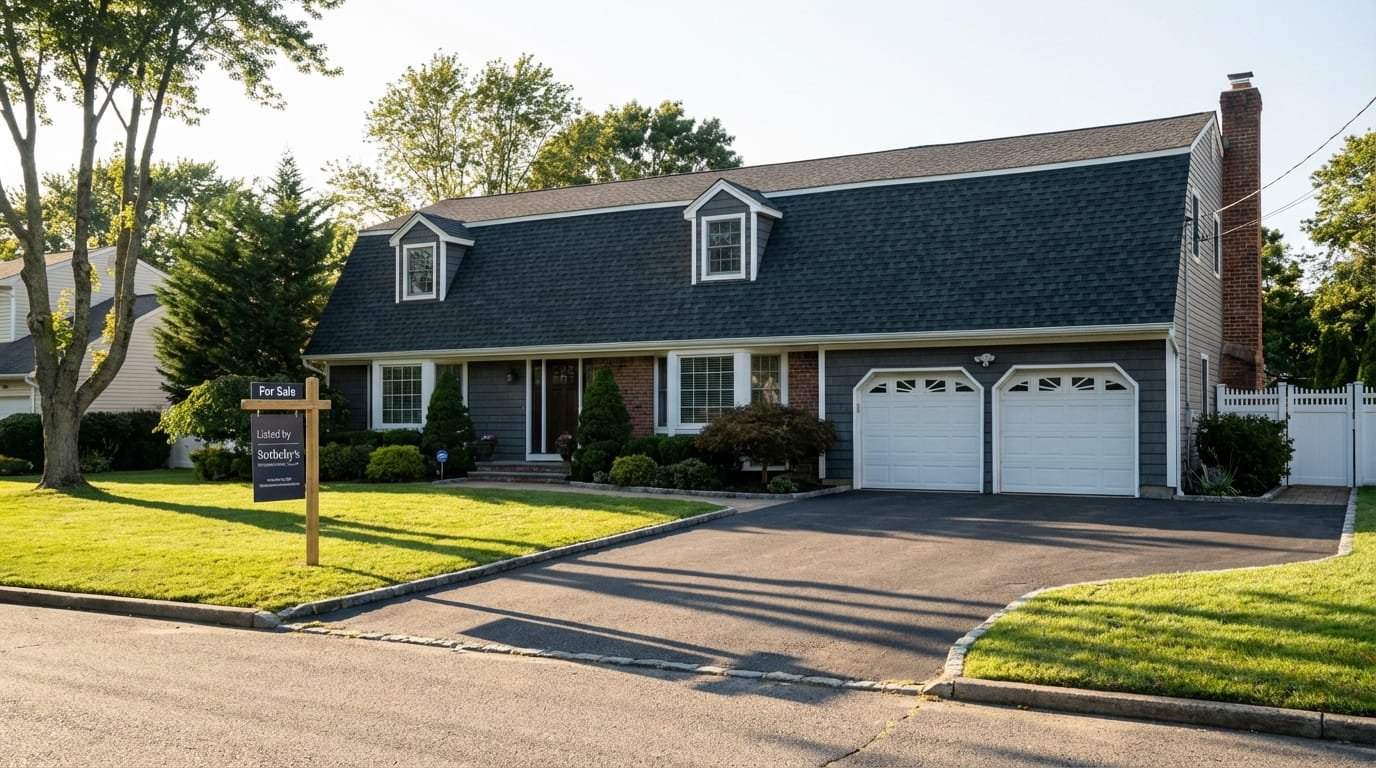
How a Roof Affects Home Value: The Real Mechanism
Before looking at ROI percentages, it is worth understanding the specific ways roof condition translates into home value, and the loss of it.
The Value Floor vs. Value Ceiling Distinction
A new roof raises your home’s value floor, ensuring buyers do not mentally deduct the cost of a future replacement from their offer. It does not, on its own, push your home above comparable sales prices in your neighborhood. Think of it this way: every buyer assumes a home comes with a functioning roof. When that assumption is violated, value is lost. When met with a brand-new roof, the lost value is recovered, plus the buyer’s peace of mind.
Replacing your roof will rarely let you sell for more than the highest-priced comparable in your neighborhood. But it will almost certainly prevent you from selling for less than you should.
How Appraisers Evaluate Roof Condition
When a buyer finances a home purchase, a licensed appraiser inspects the property. Appraisers are required to note the condition and estimated remaining useful life of the roof in their report. A roof flagged as “near end of useful life” can have direct consequences:
- The appraiser may assign a lower property value based on estimated deferred maintenance
- For FHA and VA loans, the appraiser can require roof repairs or replacement as a condition of loan approval, effectively blocking buyers using government-backed financing
- A poor appraisal report gives the buyer grounds to renegotiate the price downward after inspection
In practical terms: a roof in marginal condition does not just reduce buyer interest. It can eliminate entire categories of buyers from your pool.
How Buyers Calculate a Worn Roof
Here is a counterintuitive pattern that real estate agents observe consistently: buyers routinely overestimate the cost and hassle of replacing a roof. A roof that would cost $12,000 to replace professionally often triggers offer reductions of $15,000 to $25,000, because buyers are pricing in the inconvenience, the disruption of moving in and immediately facing a major project, and their uncertainty about the true cost.
This buyer psychology means that selling with a new roof often nets you more than the pure ROI percentage suggests. Spending $12,000 on a roof replacement to avoid a $20,000 buyer concession is a net gain of $8,000, even if the stated ROI on the roof is only 55%.
Insurance Complications: The Hidden Value Driver
According to the Insurance Information Institute, many homeowners insurance providers refuse to write new policies on homes with roofs older than 20–25 years, or they charge substantially higher premiums. When a buyer cannot obtain affordable insurance because of the roof, the transaction can fall apart entirely.
- Some insurers require a roof certification or replacement before issuing coverage
- A home that is difficult to insure reduces the pool of potential buyers, and fewer buyers means less competition and lower offers
- In some markets, a roof over 20 years old is treated by insurers as a liability that can affect the buyer’s ability to close
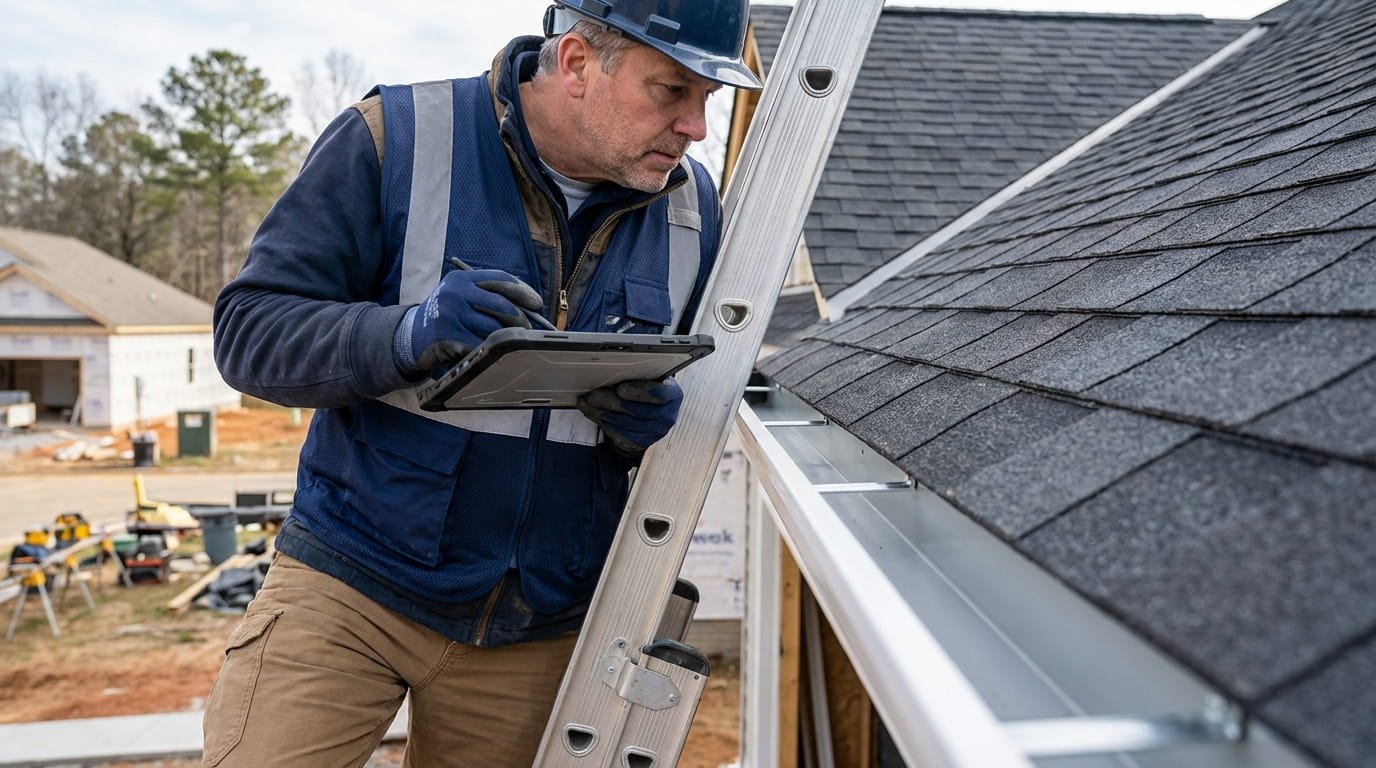
A new roof does three financially important things: it eliminates negative appraisal flags, it removes buyer concession leverage, and it keeps your home insurable. Each of these translates into real dollars, often more than the cost of the roof itself.
How Much Value Does a New Roof Add? The Numbers
The most-cited figure is that a new roof returns 50–70% of its cost at resale. Here is what that actually means, and what the raw percentage misses.
ROI by Roofing Material
| Roofing Material | Avg Cost (2,000 sq ft) | Typical ROI % | Est. Value Added | Best Market Fit |
|---|---|---|---|---|
| Asphalt shingles (architectural) | $10,000 – $18,000 | 55% | $5,500 – $9,900 | All markets |
| Metal (standing seam) | $14,000 – $35,000 | 50% | $7,000 – $17,500 | Premium / storm zones |
| Cedar shake | $15,000 – $30,000 | 57% | $8,550 – $17,100 | Historic / upscale areas |
| Clay or concrete tile | $17,000 – $30,000 | 57% | $9,690 – $17,100 | SW / Mediterranean style |
| Slate | $18,000 – $40,000 | 57% | $10,260 – $22,800 | High-end markets only |
| Asphalt (3-tab / basic) | $8,000 – $12,000 | 48% | $3,840 – $5,760 | Entry-level / budget reno |
Source: ROI figures based on Angi data as reported by Redfin (2025). Costs vary significantly by region, roof complexity, and labor rates.
The Market Condition Modifier
ROI percentages are averages, and market conditions dramatically shift the real-world numbers:
- Competitive seller’s market: buyers are less likely to walk away over roof condition. A worn roof still costs you, but buyers may absorb more of it.
- Buyer’s market: buyers have options, and any reason to hesitate sends them to the next listing. A marginal roof is a deal-killer far more often.
- High-weather-risk markets (coastal, storm-prone, freeze-thaw climates): buyers scrutinize roof condition more carefully. A new roof carries more relative weight here.
The True ROI: Accounting for Avoided Concessions
| Scenario | Roof Cost | Buyer Concession Avoided | Energy Savings (10yr) | Effective Total ROI |
|---|---|---|---|---|
| Sell within 1 year (seller’s market) | $12,000 | $10,000 – $14,000 | N/A | 83% – 117% |
| Sell within 1 year (buyer’s market) | $12,000 | $15,000 – $22,000 | N/A | 125% – 183% |
| Stay 5–10 years, then sell | $12,000 | $12,000 – $18,000 | $3,000 – $6,000 | 125% – 200% |
| Stay 10+ years, not selling | $12,000 | N/A | $5,000 – $10,000 | 42% – 83% (energy only) |
Curb Appeal and First Impressions: What Buyers Actually Notice
The roof is one of the most visible elements of a home from the street, and buyers form strong first impressions within seconds of arrival.
What a Worn Roof Signals
- Cracked, curling, or missing shingles suggest the current owner does not maintain the home, and buyers start wondering what else has been neglected
- Moss or algae growth signals trapped moisture and potential hidden rot or water damage
- Sagging areas trigger concerns about structural integrity that no amount of price adjustment can fully overcome in some buyers’ minds
- Mismatched shingle colors from previous patchwork repairs signal multiple prior problems
What a New Roof Communicates
A new or well-maintained roof sends a powerful positive signal that extends well beyond the roof itself. It tells buyers: this owner takes care of things. That halo effect extends to how buyers evaluate the HVAC system, the plumbing, the electrical, every system in the house. A new roof is curb appeal, yes, but it is also a trust signal.
Roof Color and Style: The Underrated Curb Appeal Lever
When replacing a roof, material choice is important, but so is color and style coordination. A mismatched roof can actually reduce curb appeal, while a well-chosen color palette creates a cohesive appearance that elevates the entire exterior:
- Charcoal and dark gray shingles work well with white, gray, or beige siding, which is currently the most popular combination in North American markets
- Brown and terra cotta tones complement brick, stone, and warm-toned siding
- Avoid high-contrast combinations that emphasize the roof disproportionately
- Architectural (dimensional) shingles add texture and shadow depth, appearing more premium than flat 3-tab shingles at a relatively small cost premium
Repair vs. Replace: The Decision Framework
The repair vs. replace question is the most practically important decision for most homeowners. Our guide on what roof damage is repairable goes deeper on each damage type. Here is a clear framework.
- Damage is isolated to one area or caused by a specific event
- Roof is under 15 years old and otherwise in good condition
- Repair cost is less than 25–30% of full replacement cost
- Not planning to sell within the next 12–18 months
- No widespread granule loss, curling, or brittleness
- Roof is 20+ years old, even without obvious damage
- Multiple leak areas or recurring leaks despite repairs
- Widespread granule loss visible in gutters
- Sagging or soft spots on the roof deck
- Planning to sell within 12 months or insurer has flagged the roof
Overlay vs. Tear-Off: An Important Trade-Off
When replacing an asphalt shingle roof, contractors may offer two options: a tear-off (removing existing shingles before installing new ones) or an overlay (installing new shingles directly over old ones). The overlay option saves $1,000–$3,000 in labor and disposal costs, but it comes with important downsides:
- An overlay adds weight to the roof structure, so it is not appropriate for roofs that already have two layers
- New shingles conform to the imperfections of the old layer, reducing their lifespan by an estimated 5–10 years
- Home inspectors flag overlays in their reports, and some buyers view them negatively
- Most roofing warranties require a full tear-off
Unless cost is the primary concern and you are not planning to sell within 5 years, a full tear-off replacement is almost always the better investment. The incremental cost is modest relative to the longer lifespan and cleaner inspection report.
Repair vs. Replace Decision Guide
| Situation | Recommended Action | Avg Cost | Impact on Sale |
|---|---|---|---|
| A few shingles damaged or curling | Spot repair | $150 – $500 | Minimal, repair and disclose |
| Leak in one isolated area | Targeted repair | $300 – $800 | Minimal if no structural damage |
| Repair cost >30% of replacement | Full replacement | $10,000 – $25,000+ | Strongly positive |
| Roof 20+ years old | Full replacement | $10,000 – $25,000+ | Eliminates major buyer concern |
| Sagging or structural damage | Full replacement + inspection | $12,000 – $30,000+ | Required to sell in most cases |
| Multiple overlapping repair areas | Full replacement | $10,000 – $25,000+ | Signals deferred maintenance, replace |
| Selling within 12 months | Full replacement (if roof aged) | $10,000 – $25,000+ | Removes biggest inspection risk |
Which Roofing Material Adds the Most Value?
Material choice significantly affects both cost and value return, but not always in the way homeowners expect. The highest-end material is not always the best financial choice.
Asphalt Shingles: The Volume Leader
Our shingle roofing options cover the full asphalt spectrum. Asphalt shingles cover approximately 80% of U.S. homes and provide the most predictable ROI because they match buyer expectations in most markets. Within asphalt, there is an important sub-choice:
- 3-tab shingles: flat profile, lowest cost ($8,000–$12,000), adequate protection but minimal visual premium. ROI tends toward the lower end.
- Architectural (dimensional) shingles: layered profile creates shadow lines and texture, looks significantly more premium, costs only 20–30% more than 3-tab. If you are replacing with asphalt, upgrade to dimensional.
Metal Roofing: Long-Term Premium
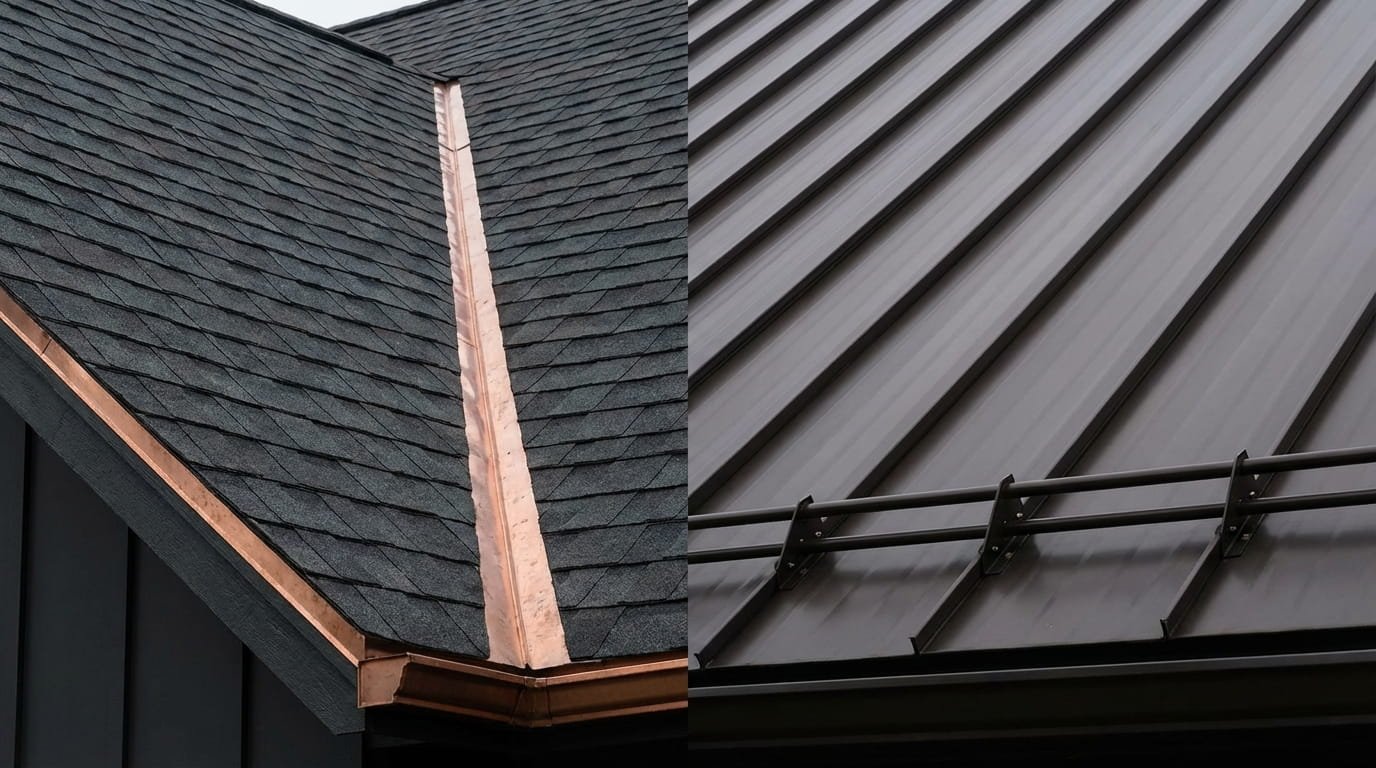
Metal roofs (particularly standing seam) are the most durable option, lasting 40–70 years with minimal maintenance. The ROI percentage (~50%) is lower than other materials because the upfront cost is higher. In storm-prone markets, the value proposition improves significantly.
The Neighborhood Conformity Rule
Your home’s value is capped by comparable sales in your neighborhood. A $35,000 slate roof on a home in a neighborhood where the median sale price is $280,000 will not return its cost. The smart strategy is “conforming upward”: choose a material that is equal to or one tier above the standard for your neighborhood.
| Material | Lifespan | Avg Cost | ROI % | Best For | Risk |
|---|---|---|---|---|---|
| Asphalt 3-tab | 15–20 yrs | $8K–$12K | 48% | Budget, entry-level | Lowest visual premium |
| Asphalt architectural | 25–30 yrs | $10K–$18K | 55% | Most markets | Best all-around value |
| Metal (standing seam) | 40–70 yrs | $14K–$35K | 50% | Premium / storm zones | High cost, lower % |
| Clay/concrete tile | 50–100 yrs | $17K–$30K | 57% | SW / Mediterranean | Weight, structural needs |
| Cedar shake | 20–35 yrs | $15K–$30K | 57% | Upscale, historic | High maintenance |
| Slate | 75–150 yrs | $18K–$40K | 57% | High-end only | Over-improvement risk |
Roof Replacement ROI: Full Cost Breakdown
National Average Costs in 2026
- Cost per square foot: $4 – $11 depending on material and region
- Total cost for an average 2,000 sq ft roof: $8,000 – $30,000
- Key cost drivers: roof size, pitch, material choice, tear-off vs. overlay, local labor rates, and permit fees
- Additional complexity (multiple valleys, dormers, steep pitch) can add 15–30% to base cost
Energy Savings: The Ongoing ROI
- Estimated annual energy savings: $300 – $600 for an average home
- Over 10 years: $3,000 – $6,000 in cumulative savings
- Energy-efficient materials (cool roofs, metal, reflective coatings) can save up to $600–$900 per year in hot climates
Insurance Premium Reductions
- Class 4 impact-resistant shingles: 5–15% discount in most markets
- Metal roofing in storm zones: 10–20% discount is common
- On a $2,000 annual premium, a 10% discount saves $200/year, which adds up to $2,000 over 10 years
The Complete ROI Picture
| ROI Component | Conservative Estimate | Aggressive Estimate | Notes |
|---|---|---|---|
| Direct resale value recovery | 50% of cost | 70% of cost | Based on Angi/Redfin data |
| Avoided buyer concessions | $8,000 – $12,000 | $15,000 – $25,000 | Depends on market and roof age |
| Energy savings (10 yrs) | $3,000 – $4,000 | $6,000 – $9,000 | Depends on material and climate |
| Insurance premium reduction (10 yrs) | $1,000 – $2,000 | $2,000 – $4,000 | Varies by insurer and material |
| Total effective return on $14,000 roof | $18,000 – $24,000 | $27,000 – $38,000 | 128% – 271% effective ROI |
Does It Make Sense If You Are Not Selling?
A significant portion of homeowners considering roof replacement are not planning to sell anytime soon. For them, the resale ROI calculation is largely irrelevant. Here is the case for replacing an aging roof even when a sale is years away.
The Compounding Cost of Delay
Roof damage does not stay contained. A small leak that costs $300 to fix in October may cause $3,000–$8,000 in water damage, mold remediation, and structural repair by the following spring if left unaddressed. The risk profile of an aging roof increases nonlinearly. A roof that is “fine” for five years may develop three simultaneous problems in year six.
Many insurers will not renew coverage on homes with roofs over 20–25 years old, forcing you to seek high-risk coverage at significantly higher premiums. An appraiser flagging an “inadequate remaining life” roof can also block a refinance. And if an aging roof fails during a weather event, the claim may be denied, as insurers may argue the damage resulted from pre-existing deterioration rather than a covered event.
| Situation (Years Remaining in Home) | Replace Now? | Primary Reason | Financial Impact |
|---|---|---|---|
| Selling in <12 months | Yes (if aged) | Inspection risk, buyer concessions | High positive ROI |
| Selling in 1–3 years | Yes (if 15+ yrs old) | Still shows as ‘newer’ at sale | Moderate-high ROI |
| Selling in 3–7 years | Yes (if 20+ yrs) | Energy savings + no emergency risk | Moderate ROI |
| Staying 7–15 years | Yes (if 20+ yrs) | Compounding water damage risk, insurance | Moderate ROI + risk avoidance |
| No plans to sell | Yes (if actively failing) | Emergency cost avoidance, insurance | Risk management priority |
| Roof is 5–10 yrs old, in good shape | No | Unnecessary, maintain and monitor | No action needed |
Maximize Your ROI: Smart Add-Ons During Replacement
A roof replacement is one of the most disruptive home improvement projects. While the contractors are already there and the roof is open, adding certain upgrades is dramatically cheaper than doing them as separate projects later.
Costs 40–60% less during replacement. ROI is among the highest of any home improvement, often reaching 100%+ through energy savings alone. Also a strong selling point.
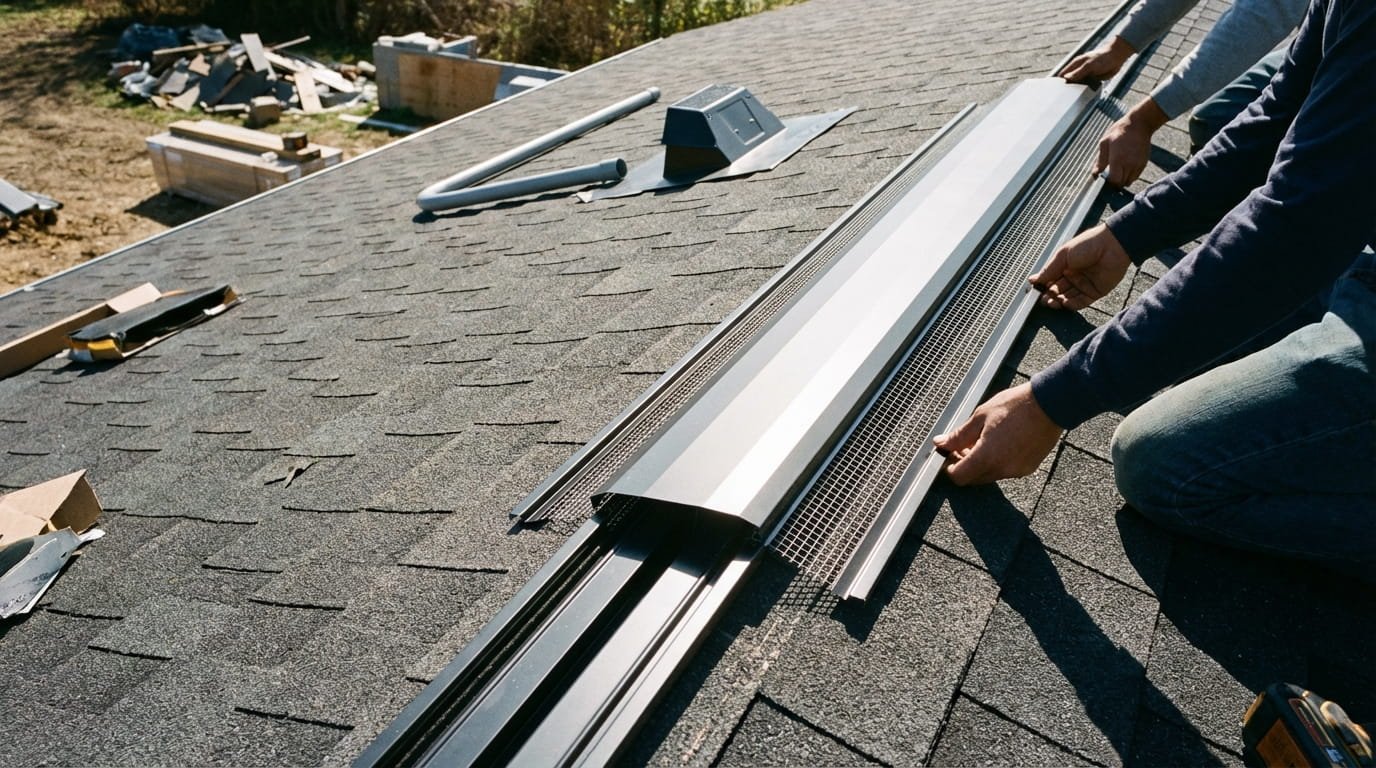
Extends a new roof’s lifespan by 5–10 years. Low-cost upgrade (typically $300–$800) with significant long-term ROI. Poor ventilation is a leading cause of premature shingle failure.
Completes the entire water management system. New gutters matching a new roof signal complete system renewal to buyers. Cost: $1,000–$3,000 depending on home size and material.
Install solar-ready mounting points now at minimal cost. Adding them after the fact requires reopening roof sections. Appeals strongly to eco-conscious buyers.
Adding a skylight during roof replacement costs significantly less than standalone installation because the roof is already open. Adds natural light, perceived space, and buyer appeal. Cost during replacement: $800–$2,500 per skylight vs. $2,000–$5,000 as a separate project.
Local Market Impact: Why Location Changes Everything
The ROI figures in this article are national averages. Your actual return depends heavily on local factors that no national study can capture.
Climate-Driven Demand
In regions with frequent storms, heavy snow, freeze-thaw cycles, or high humidity, buyers scrutinize roof condition far more carefully than in mild-climate markets. A new roof in coastal Texas or Florida carries significantly more relative value than the same roof in Phoenix, Arizona. If you live in a high-weather-risk area, the avoided-concession figure skews higher, and the effective ROI of replacement improves accordingly.
The Neighborhood Ceiling
Regardless of how good your new roof is, your home’s sale price is anchored by comparable sales in your neighborhood. Appraisers use the “comparable sales” method, meaning your home is worth what similar homes in your area have recently sold for, adjusted for condition differences. The practical implication: in an entry-level neighborhood, replace with quality asphalt shingles and do not over-invest in premium materials. In a high-end neighborhood, premium materials can fully pay for themselves because the price ceiling is high enough to absorb them.
Frequently Asked Questions
Does a new roof increase home value?
Yes, but with an important nuance. A new roof primarily prevents value loss rather than creating value above market comparables. Buyers deduct significantly more than the actual replacement cost from their offers on homes with aging roofs, so replacing an old roof typically results in a higher net sale price, even when the stated ROI percentage is below 100%. The combination of avoided buyer concessions, energy savings, and insurance benefits often makes a new roof a net-positive investment.
What is the ROI on a new roof?
The direct resale ROI ranges from 48% to 57% depending on material, based on Angi data. However, the true effective ROI, when you include avoided buyer concessions ($10,000–$25,000), energy savings over time ($3,000–$6,000 over 10 years), and insurance premium reductions ($1,000–$4,000 over 10 years), typically runs well above the headline percentage. For homeowners in buyer’s markets or storm-prone regions, the effective ROI can exceed 150%.
Should I replace my roof before selling my house?
If your roof is 20+ years old, showing visible wear, or has been flagged in a previous inspection, replacing it before listing is almost always the right financial decision. The alternative, selling as-is, means accepting buyer concessions that typically exceed the actual replacement cost, plus risking buyers walking away after inspection. If your roof is under 15 years old and in good condition, focus on any needed repairs and make sure it is clean and well-maintained.
What type of roof adds the most value to a home?
The answer depends on your neighborhood and market. For most homes, architectural asphalt shingles offer the best balance of cost and ROI. Metal roofing and premium materials (slate, tile) offer higher ROI percentages but only in markets where the price ceiling is high enough to absorb the cost. The most important rule: choose a material that matches or modestly exceeds the standard for comparable homes in your neighborhood.
How much does a roof replacement cost in 2026?
Roof replacement costs between $4 and $11 per square foot, translating to a total of $8,000 to $30,000 for most homes. Key variables include roof size, material choice, whether a tear-off is required, roof pitch and complexity, and regional labor rates. Always get three written quotes from licensed contractors and confirm whether the quote includes tear-off and disposal of the old materials.
Does a new roof help with a home appraisal?
Yes, meaningfully. Appraisers note roof condition and estimated remaining useful life in their reports. A roof flagged as “near end of useful life” can reduce the appraised value directly and can trigger loan conditions for FHA and VA buyers, effectively blocking those buyers from purchasing your home. A new roof eliminates negative appraisal flags and can prevent transactions from falling apart due to financing complications. Scheduling a professional roof inspection before listing is a smart first step.
Is it better to repair or replace a roof before selling?
If the roof is under 15 years old with isolated damage, repairs are likely sufficient. If the roof is 20+ years old, has widespread wear, or if repair cost exceeds 30% of replacement cost, full replacement is almost always the better financial decision before a sale. A partially repaired old roof still reads as an old roof to buyers and inspectors, and the psychological discount persists even if the technical function is restored.
Final Thoughts
A roof replacement is one of the few home improvements that pays for itself in multiple ways simultaneously: it recovers value at resale, prevents costly buyer concessions, reduces energy bills, lowers insurance premiums, and eliminates the risk of a failed inspection derailing a sale. The headline ROI percentage of 50–57% understates the full financial picture when you account for all of these factors.
The right decision depends on your roof’s current condition, how long you plan to stay, and your local market. Use the decision frameworks in this article as a starting point, then consult with both a licensed roofing contractor and a local real estate agent who knows your specific market. Together, those two conversations will give you a clearer picture of the true value of a new roof for your specific home.
Not sure whether your roof needs repair or replacement, or how much it would affect your home’s value? A professional roof inspection ($100–$300) gives you an objective condition report. Pair that with a conversation with a local real estate agent about recent comparable sales, and you will have everything you need to make a financially sound decision. Ready to start? Explore our roof replacement services →